OSA Fact Sheet
Obstructive Sleep Apnea (OSA) is a breathing problem that occurs when we sleep.
Do a self-screening test and organise a doctor’s referralWhat is obstructive sleep apnea (OSA)?
The upper airway keeps blocking, partially or totally, because the tongue and upper muscles in the throat relax, causing an obstruction in breathing (apnea) lasting over 10 seconds. This obstruction or pause in breathing occurs repeatedly throughout the night. The pauses are followed by gasping, snoring and/or restlessness.
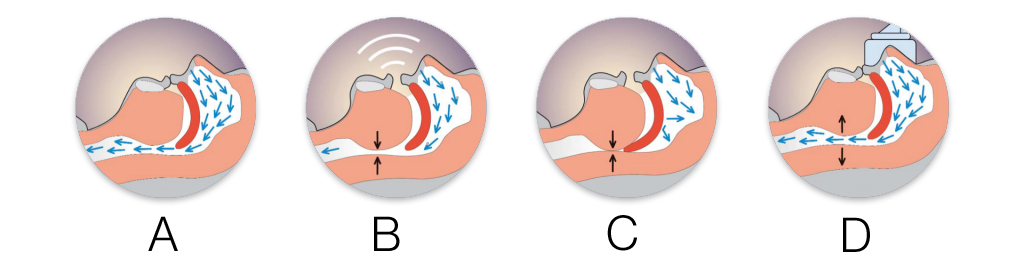
During normal sleep (A), the muscles that control your tongue and soft palate hold the airway open. If these muscles relax, your airway will become narrower (B) and the soft or floppy part of the throat vibrates; the noise of snoring results. If your throat is already narrow, or the muscles relax too much, your airway can become completely blocked (C), which prevents breathing.
People with untreated OSA can stop breathing hundreds of times per night.
A 2013 study showed that almost one in ten Australians have undiagnosed moderate-severe OSA.1
How might OSA affect me?
OSA is associated with snoring, but untreated OSA is linked with several health and wellbeing issues, including;
A 2016 Australian study showed that, compared to those without sleep apnea, men with sleep apnea had significantly poorer physical, mental, and self-rated health.11
How is OSA diagnosed?
OSA is diagnosed with a sleep study test. This involves using equipment that records your brain and heart activity, breathing, oxygen levels, and body position throughout the night. Portable equipment is available which allows the sleep study test to be performed in the comfort of your own home.
Screen yourself
Take our free 2-minute screen to understand your risk of sleep apnoea.
GP referral
Email the referral form and take it to your GP to discuss your results.
Home sleep study
Sleep in your own bed while a small device records your breathing, oxygen levels and body position.
Can OSA be treated?
Positive Airway Pressure (PAP) therapy is the recognised gold standard non-surgical OSA treatment. PAP therapy devices create a mild airflow which is delivered through a mask to your throat. The airflow creates pressure that keeps the upper airways open while you sleep, which maintains oxygen levels and stops the apnea episodes. This enables the deep and restorative sleep phases to be reached which are vital for good health.
The benefits of PAP therapy include;
- reduced risk of OSA complications
- improved glucose metabolism12
- improved sleep quality
- eliminated or reduced snoring
- reduced daytime fatigue/sleepiness
- enhanced concentration and focus
- lower blood pressure
- increased energy
- improved mood
- enhanced libido
OSA in Australia
Australians were living with obstructive sleep apnoea in 2019-20 – more than any other sleep disorder.13
How do I find out if I have OSA?
If you suspect you have OSA, it’s important to get diagnosed by a health professional and start treatment.
Whether it’s peace of mind or support to take the next step towards a healthier you, we are here to assist you on your journey.
- https://pubmed.ncbi.nlm.nih.gov/23161476/
- https://www.sciencedirect.com/science/article/abs/pii/S0022399910003727?via%3Dihub
- https://www.ahajournals.org/doi/full/10.1161/HYPERTENSIONAHA.106.076190
- https://www.ncbi.nlm.nih.gov/pmc/articles/PMC3021364/
- https://academic.oup.com/sleep/article/36/2/203/2596018
- https://www.sciencedirect.com/science/article/abs/pii/S1087079214000410
- https://www.nature.com/articles/s41443-018-0017-7
- https://www.sciencedirect.com/science/article/abs/pii/S1087079206000220
- https://journal.chestnet.org/article/S0012-3692(15)38369-0/fulltext
- https://www.tandfonline.com/doi/abs/10.1080/15389588.2019.1709175
- https://www.ncbi.nlm.nih.gov/pmc/articles/PMC5103243/
- https://pubmed.ncbi.nlm.nih.gov/24769782/
- Deloitte Access Economics (2021). Rise and try to shine: the social and economic cost of sleep disorders in Australia. Sleep Health Foundation.
- Deloitte Access Economics (2017). Asleep on the job: costs of inadequate sleep in Australia. Sleep Health Foundation.